


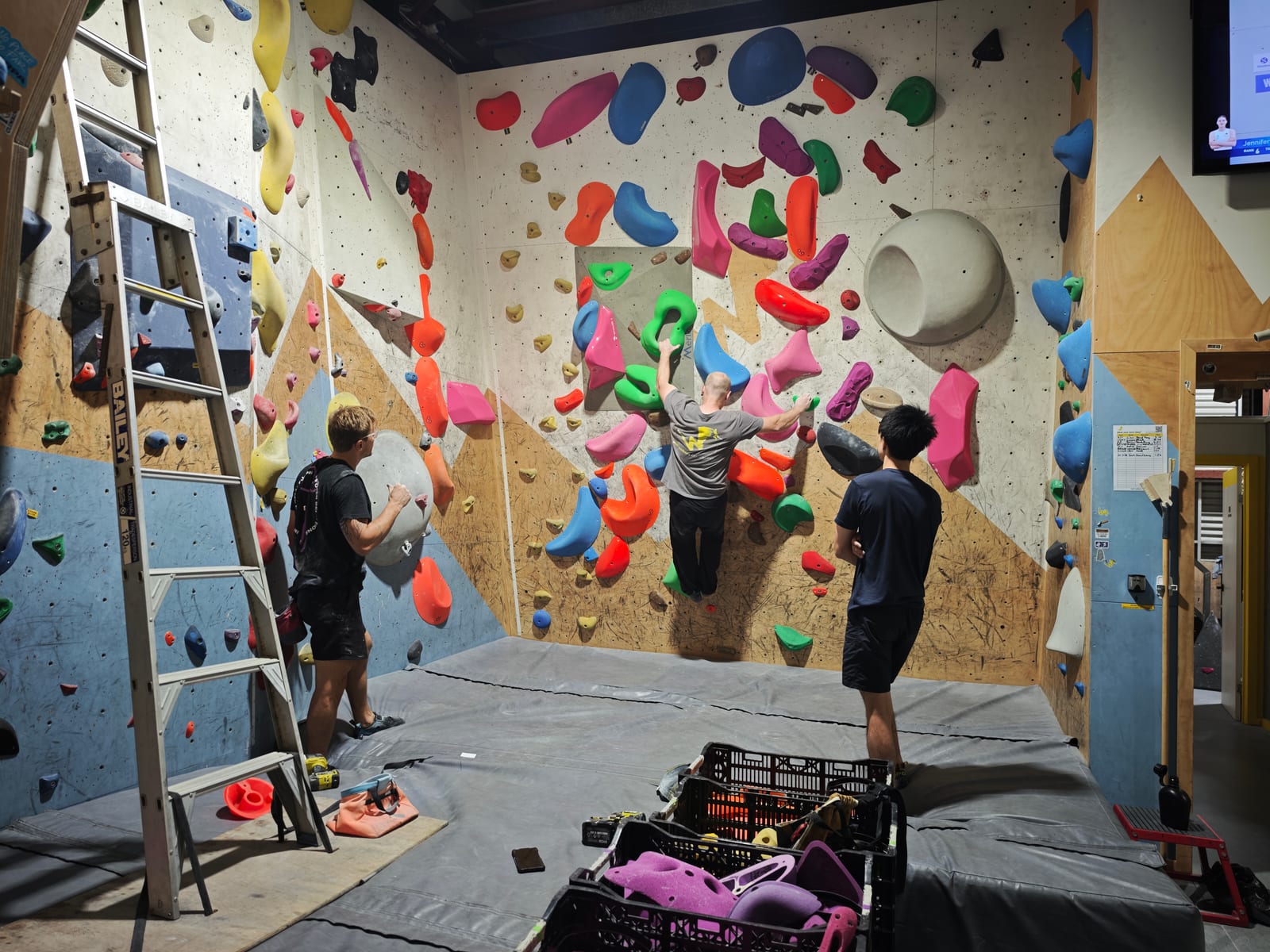
The idea of opening another Wall Walkers isn't new.
We've thought about it for years.
But thinking about opening another gym and building something that somebody else can successfully operate are two very different things.
That distinction matters.
After everything we'd been through building Wall Walkers, we knew firsthand just how much goes into starting a climbing gym.
Finding the right space.
Designing the walls.
Sourcing holds and equipment.
Insurance.
Safety.
Staffing.
Route setting.
Memberships.
Payments.
Access control.
Marketing.
Technology.
And then, once you've finally figured all of that out, you still have to actually run the business.
We learned most of those lessons the expensive way.
By doing them.
By getting things wrong.
By fixing them.
And occasionally by getting something right the first time.
As Wall Walkers evolved, though, something started to change.
We added air conditioning.
Our route setting improved.
Our membership base developed.
We introduced 24/7 access.
We built our own technology around it.
Processes that had once existed only in our heads started becoming systems that other people could follow.
Slowly, we were replacing ourselves.
And somewhere along that journey, the question changed.
It was no longer:
"Could we build another Wall Walkers?"
Of course we could.
The more interesting question became:
"Could somebody else?"
That question eventually led us towards franchising.
There wasn't one great lightbulb moment.
No meeting where we suddenly announced that Wall Walkers was going to become a franchise.
It happened gradually.
The more we systemised the business, the more obvious it became that what we'd created might be useful to somebody else.
Someone who loved climbing.
Someone who wanted to own a business.
Someone who had looked at the cost of building one of the enormous climbing facilities that dominate the industry and thought:
"There's absolutely no way I can afford that."
I understand that feeling.
Because we couldn't afford it either.
That's one of the reasons Wall Walkers exists in the first place.
Our model was born from having constraints.
We had to ask whether a climbing gym really needed to be enormous.
We had to make better use of smaller spaces.
We had to control staffing costs.
We had to build technology that allowed the business to operate differently.
And over time, those constraints became part of the model.
That got us thinking about where else something like Wall Walkers could work.
We're not trying to replace the huge warehouse-style climbing gyms.
They serve a market and do it extremely well.
We're interested in something different.
Smaller gyms.
Smaller communities.
Locations where building a multi-million-dollar climbing facility may simply never make sense.
A Wall Walkers location doesn't necessarily need to be enormous to create a great climbing experience.
Our current thinking is that around 200 square metres provides a sensible starting point for the model, while some markets may support something smaller depending on the location, demographics and economics.
That opens up possibilities.
And that's ultimately what interests me about franchising.
Not simply putting the Wall Walkers logo on more buildings.
Giving somebody else a starting point we never had.
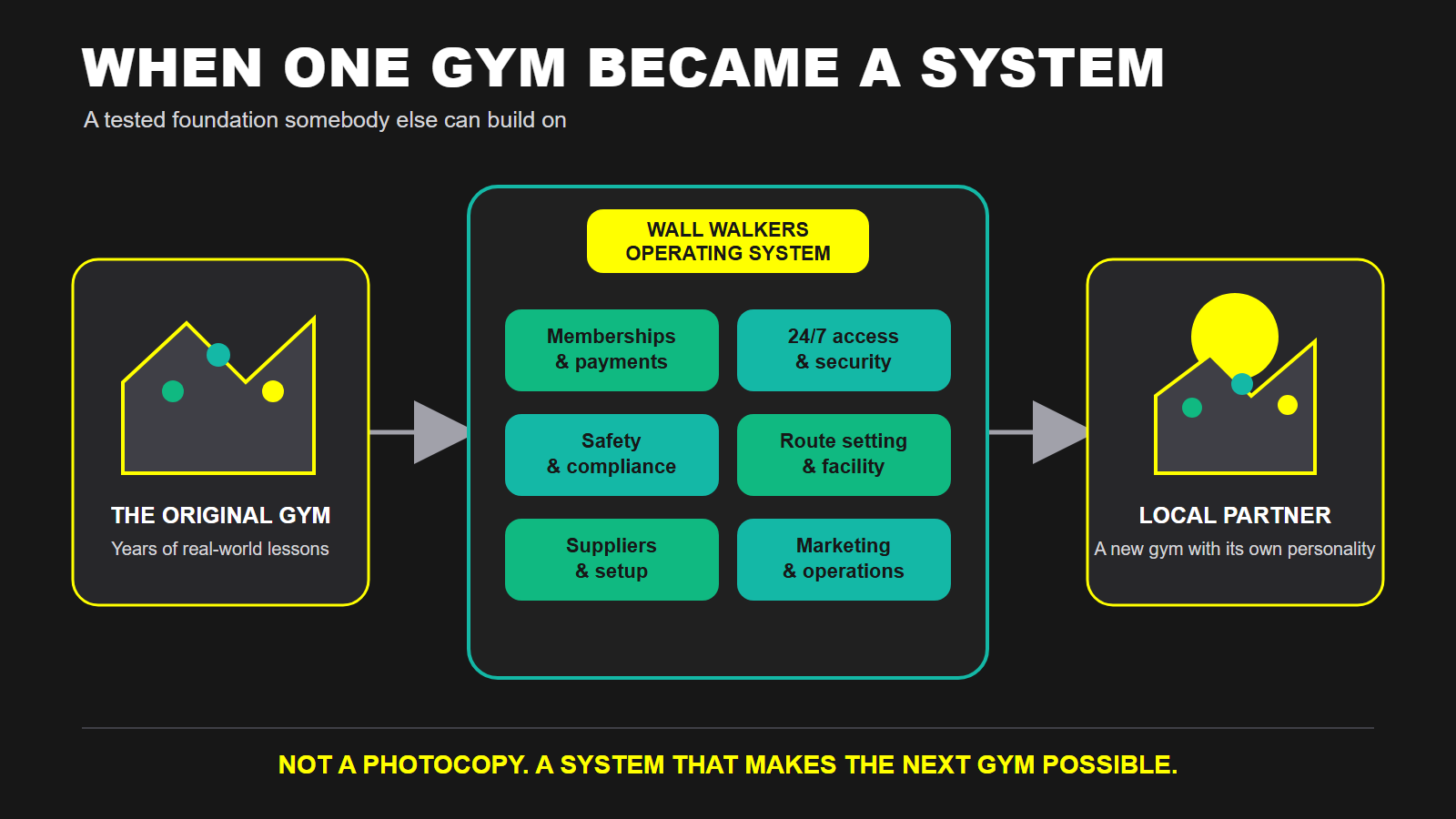
The systems.
The experience.
The mistakes.
The suppliers.
The technology.
The operating model.
The knowledge we've accumulated from years of actually running the business.
Instead of beginning with a blank piece of paper and asking:
"How the hell do I build a climbing gym?"
Someone can start several steps further down the road.
Of course, franchising introduces an entirely new set of challenges.
We discovered that very quickly.
Legal requirements.
Documentation.
Processes.
Procedures.
Financial modelling.
Compliance.
Finding the right advisers.
Making sure that what we're offering is properly structured and legitimate.
There is also something incredibly important that needs to be said.
A franchise isn't a guarantee of success.
It's still a business.
There is still risk.
Location matters.
Execution matters.
Costs matter.
The person operating the business matters.
I would never want to tell somebody that opening a Wall Walkers franchise means they're guaranteed to succeed.
What we can do is give them the benefit of what we've learned.
We can give them a model that's been tested in the real world.
And we can stand behind the fact that the original Wall Walkers is still here, still operating, still learning and still improving.
That's what gives me confidence to take this next step.
There's another reason we're doing it too.
Over the years I've realised that I don't particularly want Wall Walkers to be something that depends entirely on me.
I want to build something capable of outliving its founders.
Something other people can take, contribute to and improve.
And maybe that's the part of franchising that excites me most.
I hope people build cool shit.
I hope somebody who has dreamed about opening their own climbing gym, but didn't have the money, experience or knowledge to start completely from scratch, looks at what we've built and thinks:
"Maybe I actually can do this."
Then I hope they take the foundations we've created and build something they're proud to call their own.
Because the goal isn't to create dozens of identical copies of our gym.
It's to take everything we've learned building Wall Walkers and use it to help other people create great climbing spaces in their own communities.
We've spent years figuring out how to build ours.
Now we're ready to see what other people can build with it.
A Lesson We Didn't Expect
We didn't set out to build a franchise.
We set out to solve problems.
One by one, those solutions became processes.
The processes became systems.
And eventually we looked at everything we'd built and realised that those systems might be valuable to somebody other than us.
Sometimes scalability isn't something you design at the beginning.
Sometimes it's what emerges after you've spent years making something work.
What I'd Tell Someone Starting Today
You don't need to know how to build everything from scratch.
Sometimes the smarter starting point is finding people who have already made the mistakes you're about to make.
Learn from them.
Use what works.
Then bring your own ideas, skills and passion to it.
And if you're going to build something...
Build something of your own.